Skills Assessment
Goal: Record baseline and final skill ratings for students, track growth, and manage the skills catalog.
Skills assessments measure a student's practical competency in specific areas. Each skill is rated on a 1-10 scale at the start (baseline) and end (final) of their cohort.
How Skills Work
- A baseline rating is recorded when a student starts a class — this is their initial skill level
- Throughout the cohort, the student develops skills through hands-on training
- A final rating is recorded at the end of the cohort — this measures growth
- The system calculates the growth (final − baseline) automatically
Rating Guide: What the Numbers Mean
Use this guide to calibrate your ratings. Every score should mean the same thing regardless of who is rating or which location. When in doubt, default to the lower rating — students should earn their scores through demonstrated behavior.
Scale overview:
- 1–2: No experience or significant concerns
- 3–4: Below expectations, needs regular support
- 5–6: Meets basic expectations with occasional reminders
- 7–8: Consistently strong, minimal supervision needed
- 9–10: Exceptional, could mentor others
Soft Skills
Punctuality
| Rating | What it looks like |
|---|---|
| 1 | Regularly arrives 15+ minutes late or doesn't show up without notice |
| 3 | Often 5–10 minutes late; needs reminders about start times |
| 5 | Usually on time but occasionally late; communicates delays when prompted |
| 7 | Consistently on time; proactively texts if running late |
| 10 | Always early; ready to work at start time; never misses without advance notice |
Teamwork
| Rating | What it looks like |
|---|---|
| 1 | Refuses to work with others; causes conflict on the job site |
| 3 | Will work alongside others but doesn't contribute; waits to be told what to do |
| 5 | Cooperates when assigned a team task; does their share but doesn't volunteer |
| 7 | Actively helps teammates; shares tools and materials without being asked |
| 10 | Natural team player; steps in where needed, resolves minor conflicts, lifts the whole crew |
Communication
| Rating | What it looks like |
|---|---|
| 1 | Won't speak up; ignores instructions; can't explain what they're working on |
| 3 | Gives one-word answers; doesn't ask questions even when confused |
| 5 | Communicates basic needs; asks for help when stuck but doesn't volunteer information |
| 7 | Clearly explains their work; asks good questions; reports problems before they escalate |
| 10 | Communicates professionally with staff, peers, and visitors; gives clear status updates; listens actively |
Time Management
| Rating | What it looks like |
|---|---|
| 1 | Cannot stay on task; spends most of the day off-track or on their phone |
| 3 | Needs frequent redirection; starts tasks but drifts; underestimates how long things take |
| 5 | Can follow a schedule when given one; occasionally loses focus but gets back on track with a reminder |
| 7 | Plans their work steps; uses time well; transitions between tasks without downtime |
| 10 | Self-directed; finishes tasks early and moves to the next one; helps plan daily workflow for the group |
Work Ethic
| Rating | What it looks like |
|---|---|
| 1 | Does the minimum or less; walks away from tasks; complains about assignments |
| 3 | Completes tasks when directly supervised but stops when no one is watching |
| 5 | Does what's asked without complaint; consistent effort but doesn't go beyond the assignment |
| 7 | Takes pride in their work; stays busy without prompting; cleans up their area without being told |
| 10 | Goes above and beyond; volunteers for hard jobs; treats every task like it matters; shows up hungry to learn |
Attitude & Coachability
| Rating | What it looks like |
|---|---|
| 1 | Hostile to feedback; argues with instructors; shuts down when corrected |
| 3 | Accepts correction but visibly frustrated; makes the same mistakes repeatedly |
| 5 | Takes feedback without pushback; applies corrections most of the time |
| 7 | Welcomes feedback; asks follow-up questions; visibly improves after coaching |
| 10 | Seeks out feedback proactively; applies corrections immediately; encourages peers to do the same |
Problem Solving
| Rating | What it looks like |
|---|---|
| 1 | Freezes when something goes wrong; waits for someone else to fix it |
| 3 | Recognizes a problem but can't figure out next steps without help |
| 5 | Can troubleshoot basic issues (wrong measurement, misaligned cut) with some guidance |
| 7 | Works through problems independently; tries multiple approaches before asking for help |
| 10 | Diagnoses issues quickly; improvises solutions with available materials; helps others troubleshoot |
Hard Skills
Tool Safety
| Rating | What it looks like |
|---|---|
| 1 | Handles tools dangerously; doesn't wear PPE; has caused or nearly caused an injury |
| 3 | Wears PPE when reminded; forgets to check guards or disconnect power before adjustments |
| 5 | Follows safety rules consistently but needs occasional reminders on less obvious hazards |
| 7 | Models safe behavior; checks equipment before use; stores tools properly every time |
| 10 | Safety-first mindset; spots hazards others miss; reminds peers about PPE and safe practices |
Following Written Instructions
| Rating | What it looks like |
|---|---|
| 1 | Cannot follow written steps; ignores written instructions; needs everything explained verbally |
| 3 | Reads instructions but skips steps or misunderstands key details; needs frequent clarification |
| 5 | Follows standard written procedures with occasional questions; completes multi-step instructions with some guidance |
| 7 | Reads and follows written work orders, safety procedures, and manuals independently; catches important details |
| 10 | Follows complex written procedures accurately on first read; identifies errors in written instructions; helps peers interpret documentation |
Safety Awareness
| Rating | What it looks like |
|---|---|
| 1 | Unaware of surroundings; walks under loads; ignores caution tape and signage |
| 3 | Knows basic rules but doesn't scan for hazards; reacts to problems instead of preventing them |
| 5 | Aware of common hazards; follows posted safety procedures; participates in safety briefings |
| 7 | Actively scans the work area; secures loose materials; speaks up about unsafe conditions |
| 10 | Thinks two steps ahead about safety; leads toolbox talks; makes the job site safer for everyone |
Measurement & Layout
| Rating | What it looks like |
|---|---|
| 1 | Cannot read a tape measure; doesn't understand fractions or basic units |
| 3 | Reads whole inches but struggles with fractions; layout lines are inconsistent |
| 5 | Measures accurately to 1/8"; can mark and snap a chalk line; basic layout with guidance |
| 7 | Accurate to 1/16"; lays out walls, stud spacing, and openings independently; checks square and level |
| 10 | Precise and fast; handles complex layouts (stairs, roof angles); double-checks critical measurements automatically |
Equipment Operation
| Rating | What it looks like |
|---|---|
| 1 | Has never operated the equipment; unsafe to operate without direct supervision |
| 3 | Can start and stop equipment but doesn't understand controls or maintenance |
| 5 | Operates common equipment (drill, circular saw, air compressor) with basic competence |
| 7 | Runs multiple pieces of equipment confidently; performs daily maintenance checks |
| 10 | Expert-level operation; handles specialized equipment; trains others on proper use |
Tool Proficiency
| Rating | What it looks like |
|---|---|
| 1 | Cannot identify common hand tools; doesn't know which tool to use for a given task |
| 3 | Knows basic tools (hammer, screwdriver, pliers) but struggles with proper technique |
| 5 | Uses common hand and power tools correctly; selects the right tool for standard tasks |
| 7 | Skilled with a wide range of tools; efficient technique; maintains tools properly |
| 10 | Master-level proficiency; uses specialty tools; can improvise with what's available |
Technical Accuracy
| Rating | What it looks like |
|---|---|
| 1 | Work is consistently wrong; doesn't follow specs; makes errors that require rework |
| 3 | Gets close but misses tolerances; needs rework on most tasks |
| 5 | Meets specs on straightforward tasks; occasional errors on complex work |
| 7 | Consistently accurate; work meets or exceeds tolerances; rarely needs correction |
| 10 | Precision work every time; catches errors before they become problems; sets the standard for the class |
Quality of Work
| Rating | What it looks like |
|---|---|
| 1 | Work is sloppy; visible defects; doesn't care about the finished product |
| 3 | Completes tasks but finish quality is poor; rough edges, gaps, uneven surfaces |
| 5 | Acceptable quality on standard tasks; takes shortcuts occasionally but fixes when called out |
| 7 | Clean, professional-quality work; takes pride in finish details; self-inspects before calling it done |
| 10 | Portfolio-worthy craftsmanship; work could pass a client walkthrough; mentor-level attention to detail |
Print this guide and keep it at each location. When recording baselines, have two staff rate the same student independently — if scores differ by more than 2 points, discuss and calibrate.
Recording a Baseline Rating
- Open the student's Detail Page
- Scroll to the Skills section
- Click Add Baseline Assessment
- For each skill in the catalog:
- Rate the student from 1 (no experience) to 10 (expert)
- Add optional notes about the assessment
- Click Save
Be consistent with your baseline ratings. A "5" should mean the same thing whether you're rating a student in Medford or Grants Pass. Discuss calibration with your team at the start of each term.
Recording a Final Rating
- Open the student's Detail Page
- Scroll to the Skills section
- Click Add Final Assessment
- Rate each skill from 1-10
- Click Save
The system immediately shows the growth comparison — baseline vs. final side by side.
Viewing Growth
On the student's detail page, the Skills section shows:
- Baseline score per skill
- Final score per skill
- Growth (final − baseline) with positive growth highlighted in green
This data is also available in the Report Builder for aggregate analysis across classes and locations.
Managing the Skills Catalog
Available to: Super Admin, Director
The skills catalog defines which skills are available for assessment. To manage it:
- Click Manage Skills in the sidebar under Program
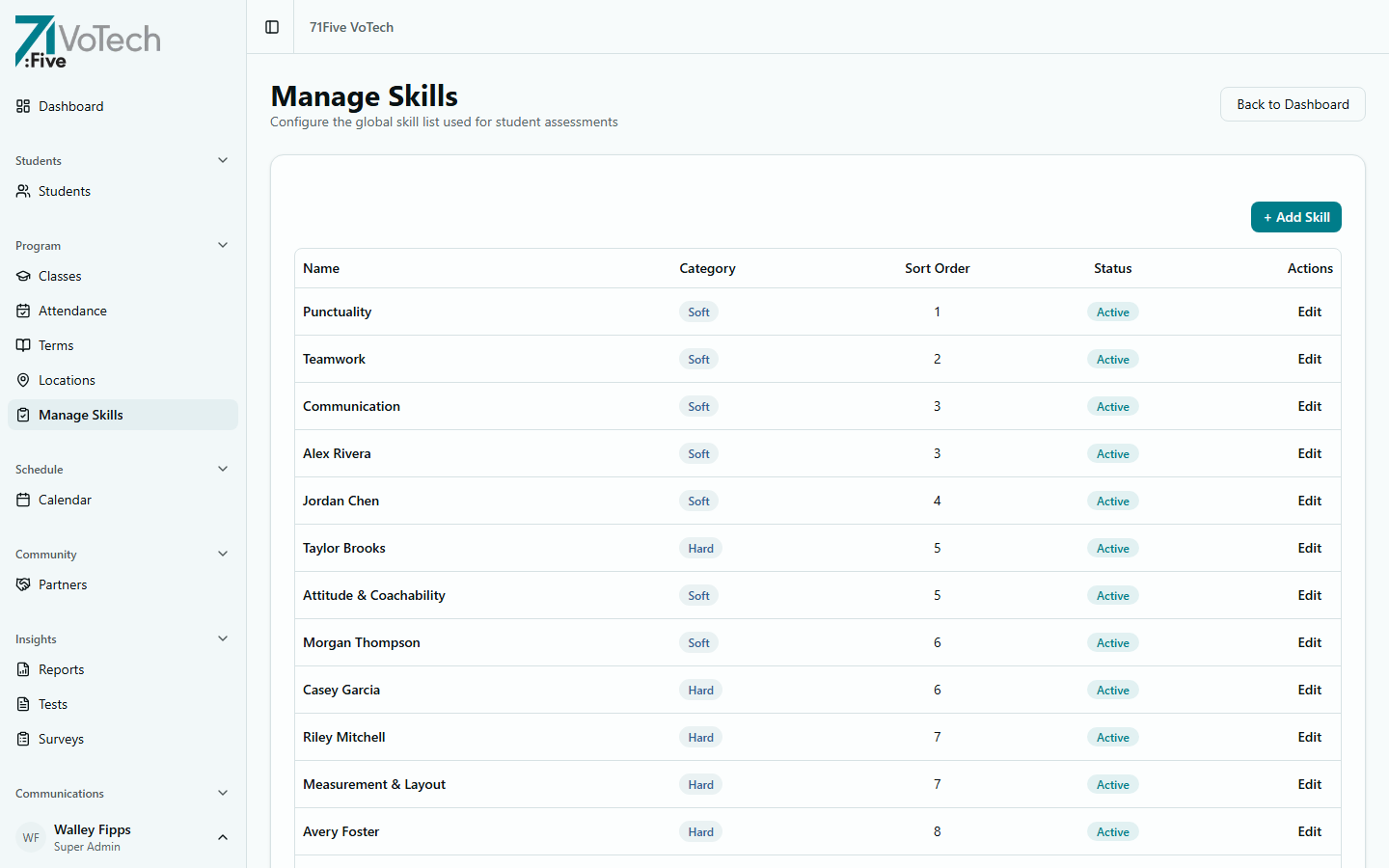
- You can:
- Add a skill — name, description, and which categories it applies to
- Edit a skill — update the name or description
- Deactivate a skill — remove it from future assessments (existing records are preserved)
Deactivating a skill doesn't delete historical ratings. Students who were already rated on that skill keep their records. The skill simply won't appear in future assessments.
Who Can Do What
| Action | Super Admin | Director | Case Manager | Coordinator |
|---|---|---|---|---|
| Record baseline/final ratings | Yes | Yes | Yes | Yes |
| View skill growth | Yes | Yes | Yes | Yes |
| Add/edit skills in catalog | Yes | Yes | No | No |
| Deactivate skills | Yes | Yes | No | No |
Tips & Common Mistakes
Don't skip baseline assessments. Without a baseline, VoTech can't calculate growth — and growth metrics are key for grant reporting (BOLI, YDD).
Record baselines in the first week of the cohort, before any significant instruction. This gives the most accurate picture of growth.
Related Guides
- Student Detail Page — view skills per student
- Tests & Grading — knowledge assessment
- Report Builder — aggregate skill growth across students